Contents
1. Two systems, different inputs2. Four complementary taxonomies3. Edge cases are reference points4. Encoding, filtering, generation and rewards5. Diverse data without false coverage claims6. One character, several kinds of evidence7. Find the right referenceHumaneness PerformanceNet
Human performance,
made legible.
Two systems. Four complementary taxonomies.
Analyze a script to design a virtual actor. Annotate a recorded or generated scene to describe what is observable. Use a shared vocabulary to select diverse data, construct generation prompts and develop grounded model supervision.
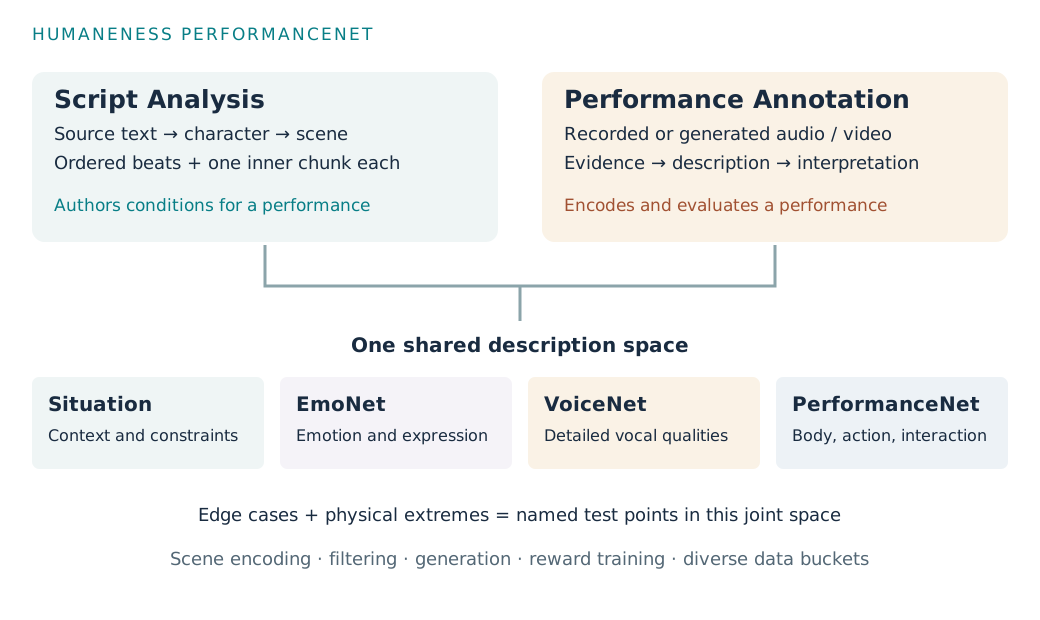
Two systems, different inputs
Humaneness PerformanceNet connects the design of a performance with the structured description of a performance. The connection is shared language, not an assumption that a requested state can be recovered from a recording.
Humaneness Script Analysis System
Start with a book, screenplay, stage play, radio script or authored scene. Establish the character’s physical, emotional, intellectual and psychological makeup. Interpret the scene’s seven Dramatic Obligations through that makeup, including its Emotional Obligation. Divide the performance into ordered Acting Beats. Each beat carries concrete dialogue, action, silence and delivery instructions plus exactly one nested Experience Chunk for the character’s authored inner stream. A generator uses these inputs to produce audio or audiovisual performance.
Humaneness Performance Annotation System
Start with recorded real-world behavior, a staged reference performance or generated media. Establish what the available audio and video make observable. Use time-linked events, descriptive dimensions and source-aware interpretation to encode the scene. Keep observer response and task-fit evaluation in separate fields. The same scene can support model training, data selection and review without treating its description as proof of private psychological facts.
Four complementary taxonomies
| Vocabulary | What it contributes | How to use it |
|---|---|---|
| PerformanceNet Taxonomy | 82 descriptive fields: 79 ordinal scales and three categorical capture fields. Eight observer-impression scales are a separate layer. | Describe attention, action, body, interaction, multimodal coherence and other performance qualities. |
| VoiceNet Taxonomy | A specialist vocabulary for vocal qualities, with the actual ranges and anchor directions of the chosen codebook. | Describe or target audible delivery in greater detail. Do not assume every field has the same scale. |
| EmoNet Taxonomy | 40 emotion/state labels and 320 intensity–expression cells. | Specify whether a label concerns authored feeling, requested expression or an observer’s interpretation. |
| PerformanceNet Situation Taxonomy | Source situation domains and scenarios, retained extensions and explicit contextual facets for specialized cases. | Locate ordinary and extreme performance problems within a broader scene context. |
These vocabularies overlap in subject matter but do different jobs. A loud voice is not automatically anger, an emotion is not a situation, and an observed motion is not a complete explanation of a character’s motive. Store each label with its namespace, definition, evidence source and relevant interval.
Edge cases are reference points
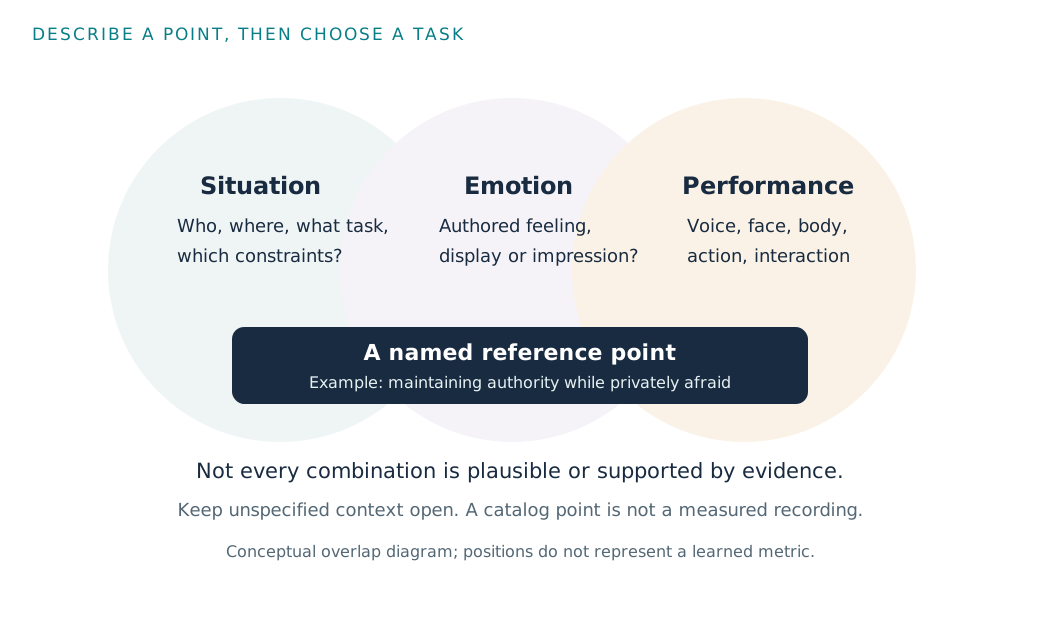
The 266 acting edge cases and 600 physical-extreme premises are named test points. They emphasize combinations that ordinary conversation and common web video may rarely contain: exertion while speaking, threat under controlled authority, sensory overload, conflicting impulses, restricted movement or an abrupt change in task demands. Their presence in the catalog says nothing about their frequency in a training corpus.
A reference point can combine a situation with emotion, voice and performance descriptors. Some cases name only a delivery style or an emotional display. They remain useful points in the joint space while leaving scene context unspecified. Adding an invented setting merely to fill a taxonomy field would make the map less faithful.
The situation crosswalk distinguishes exact source matches, broader domain compatibility, proposed contextual extensions and missing context. Its evidence snippets explain why a tag was assigned. The original catalogs and identifiers remain available in Appendices D–F; the machine-readable mapping exposes individual decisions for review.
One vocabulary, several workflows
Encode scenes for omni-models
An annotation converts a scene into explicit statements, events and dimension values tied to available modalities and time intervals. This can serve as structured supervision or an intermediate semantic representation for a model that handles text, audio and video. It is a human-readable encoding proposal, not a claim to capture everything a model or socially skilled observer can perceive.
Filter existing recordings
Choose target descriptor combinations and generate retrieval or review prompts across them. Ask for supporting evidence and rejection reasons. Keep unavailable labels null and record alternative interpretations. Audit accepted clips so the filter does not merely repeat its prompt’s assumptions. Source annotations and prompt targets remain separate records.
Generate synthetic performances
Sample a plausible scene and selected performance demands. Use Script Analysis to give those demands a character, relationship, objective and beat structure. Request the actual words or actions, then annotate the generated result independently. A requested extreme does not count as successful coverage until the output supports it.
Train and evaluate reward models
Performance annotations can provide auxiliary labels, task-conditioned comparisons and evidence for preference judgments. A later trained reward model may learn from those labels. The taxonomy itself is not a reward model. A scale value is also not a universal quality score: more tension, louder speech or larger movement can improve one scene and damage another. Declare the task and preference criterion, calibrate raters, retain uncertainty, and test held-out situations, speakers and generators.
Diversity is a sampling problem
The catalogs help specify what to look for. The corpus determines what is actually available.
- Describe the target. Select situation domains and facets, emotion/state roles, vocal demands and performance variables. Include ordinary, transitional and extreme cases.
- Choose plausible combinations. Use named reference points as seeds, then vary partners, stakes, language, setting and delivery where the source allows. Do not assume every Cartesian combination makes dramatic sense.
- Retrieve or generate candidates. Keep the prompt, source IDs and sampling choices attached. A filter and a generator use different instructions even when they share target descriptors.
- Annotate the evidence. Record observed intervals, modality access and uncertainty. A target label copied from a prompt is not an annotation.
- Measure occupied buckets. Count accepted clips by supported combinations; keep missing-context and unknown-evidence buckets visible. Report both marginal and selected joint coverage.
- Control repetition. Track duplicate clips, near-duplicate performances and repeated speakers or scenes. Use documented caps or weights, then inspect rare and ambiguous buckets.
The same scene, separate accounts
A fictional emergency coordinator fears that a colleague is missing while telling another person to keep a radio channel open. This is an authored design example; no analyzed recording is supplied.
| Layer | What belongs here |
|---|---|
| Script Analysis | Persistent competence and control; responsibility to the partner; fear and a competing urge to ask for reassurance; the exact line and intended restrained authority. |
| Situation coordinates | An emergency communication task, incomplete information and consequential stakes, where supported by the source. Unspecified physical conditions stay open. |
| EmoNet / VoiceNet / PerformanceNet targets | Requested emotional relation and delivery constraints, each identified as authored targets rather than measurements. |
| Performance Annotation | Only after a clip exists: the words, timing, breath, gaze or bodily action actually available, then qualified interpretation. Until then, observed fields are unfilled. |
| Task-fit or reward label | A separate judgment of whether this output fulfills the communication task while serving the intended dramatic relationship. It need not display fear conspicuously. |
Find the right reference
Read the two system guides for the workflows, then use the named taxonomy volumes for definitions. Appendices A and B retain full PerformanceNet anchors; C retains the EmoNet registry; D–F retain situation, edge-case and physical-extreme catalogs; G covers surface/underlying combinations; H contains the Morris index and character questions; I covers non-speech events; J preserves source provenance and historical production notes.
The website offers a searchable case explorer, a prompt-drafting interface and direct HTML/PDF access to all volumes. The downloadable JSON crosswalk is reviewable record by record. Full source citations and exceptions live with the relevant taxonomy, rather than being hidden in a universal scale claim.
Humaneness PerformanceNet is an integrated research and design framework. Its proposed mappings, supervision formats and model uses remain open to empirical evaluation. The supplied historical illustrations retain their original Actor-State Atlas lettering; the current names and roles are defined in this guide.